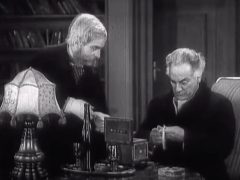
In Jewels – recently restored by Filmarchiv Austria and presented to the audience on the new channel Filmarchiv On – Hans Brückner adopted a courageous and rather innovative directorial approach, drawing heavily on what had been made in the past, but at the same time treasuring numerous influences from the rest of the world.
Who was Edgar Allan? is a sophisticated detective story with a noir character in which a Venice that is often quite different from how we are used to imagining it acts as the perfect co-star. Michael Haneke, for his part, has succeeded perfectly in staging an intriguing yet twisted and highly controversial story.
Die Tat des Andreas Harmer is an extremely sophisticated noir, where – just as the great Fritz Lang had shown us in Metropolis in 1926 – the clear separation between good and evil is well represented on two levels by the settings, be they the basement of a building and the sewers of the city or a sunny park on a hot summer’s day.
No one is really innocent in Life eternal. And even if past faults come to the surface, we gradually discover that those whom we initially considered to be completely negative, also have a tender and friendly nature after all.
The Vienna of Mann im Schatten is a dark, shadowy Vienna, witness to the most horrific crimes, which, in its time, Carol Reed had so well depicted in The Third Man. And director Arthur Maria Rabenalt was equally able to stage a brutal crime, drawing heavily now from Reed’s own cinema, now from German Expressionism, now even from the legendary figures of detectives like Hercules Poirot or Lieutenant Columbo.
Drawing heavily from American noir films, as well as from the successful French polar films, Torment of the Flesh takes its cue from a series of feature films produced in Austria from the immediate post-war period, in which for the first time – just as had happened in Italy with Neorealism – there was talk of poverty and of the numerous consequences – moral and material – that the war had had on the entire population.
In Das Manifest, Antonis Lepeniotis, through a sophisticated and minimalist direction, has staged a world in which there is no consideration for the human being and for his freedom. A world in which a ruthless police force has the last word at any cost. A world in which there is apparently no hope for a better future and within which one feels as if imprisoned in a real vicious circle.
In Nikolaus Leytner’s Half a Life, alongside a clear television character, far more complex moral issues concerning anger, resentment, deep sorrow and, last but not least, a heartbreaking sense of guilt are raised.
An Alibi for Death, directed by Alfred Vohrer, is a striking thriller, shot entirely in Vienna, with a hybrid mise-en-scène, a welcome international touch and a (not too) subtle feminist character, although it also includes a certain (not always) understandable basic naivety.
With a good touch of irony and just as a strong criticism of the National Health Service (and others), Wolfgang Murnberger’s Come Sweet Death sees its protagonist – played by comedian Josef Hader – as a sort of unintentional hero, an apparently bored man who does nothing but turn to alcohol and smoking to forget his loneliness. The director, on the other hand, does not hesitate to show us the worst of society without sparing us anything.