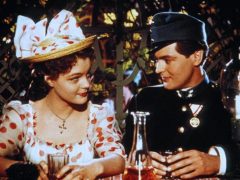
Die Wirtin von Maria Wörth fits perfectly within the conventions of the Heimatfilm genre, which continued to be the favourite genre of the major national production companies. And so, this feature film by Eduard von Borsody tells through images the story of a musical romance that favours the style of a comedy of errors over drama.
A March for the Emperor is a milestone in Austrian nostalgic cinema, capable of transforming history into a lively and visually captivating operetta that entertains and offers a welcome break from reality at the same time.
In Die junge Stadt, we are shown all the major innovations for children introduced in Vienna in the years immediately following World War II. Restored by Filmarchiv Austria and shown on the Filmarchiv On channel.
If we consider that Vienna, City of my Dreams was made in the late 1950s, at a time when national cinema had long been seeking to move in new directions, we realise how it can be regarded as a “nostalgic” film. Willi Forst sought to create a heartfelt tribute to his city, but also to an essential era in Austrian film history. Restored by Filmarchiv Austria and presented on the Filmarchiv On channel.
With On These Evenings, it had become clear which direction Austrian cinema was heading in. The desire to experiment was growing ever stronger. So was the desire to leave behind a past that was perhaps a little too ‘burdensome’. Restored by Filmarchiv Austria and presented on the Filmarchiv On channel.
Das Mädchen vom Pfarrhof was often criticised by the press as a ‘’not very bold’ film that distanced itself too little from the conventions of the Heimatfilms of the time. Yet, despite everything, this feature film by Alfred Lehner works.
In The Priest and the Girl, Gustav Ucicky was not afraid to tackle rather sensitive issues. Yet the film was made in the late 1950s, when there were many “external” restrictions on staging such a story.
Although an overall pleasant staging, Scandal in Bad Ischl appears rather anachronistic today. What remains is the image of an era and a society that was at times too close-minded and often ridiculous, in a pleasant hour and a half.
Marika is a cheerful, lively and – also in a metaphorical sense – wonderfully colourful feature film. The first colour film in Austrian film history.
Loving Couples is a perfect example of a 1950s Austrian comedy, full of light-hearted songs and complicated situations that, in one way or another, knows how to make people smile with funny jokes, which, as we know, will never fall out of favour.