The Prince and the Dancer cannot simply be considered a light-hearted love story or a simple comedy of errors. What emerges, in fact, is also a strong critique of society which, regardless of the historical period in question, never seems truly immune to certain dynamics. Restored by Filmarchiv Austria and presented on the Filmarchiv On channel.
At a time when the consequences of the recent war were still quite evident, the image of a nation doing everything it could to start over was undoubtedly quite powerful. The documentary Leben am Wiener Naschmarkt, along with many other films of its kind, had precisely this aim. Restored by Filmarchiv Austria and presented on the Filmarchiv On channel.
Die alte Hungerburgbahn adopts a purely classic and linear directorial approach which, further enriched by a welcome touch of irony, has proved to be the right way to give us a comprehensive insight into life in that corner of Tyrol a few years after the end of World War I. Restored by Filmarchiv Austria and presented on the Filmarchiv On channel.
The short documentary Salzburg um 1920 is a little gem of Austrian film history, but also an important document that offers a glimpse into life at that time. Restored by Filmarchiv Austria and presented on the Filmarchiv On channel.
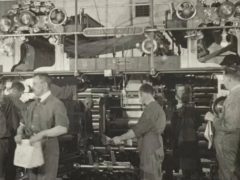
With few captions and a directorial approach that could almost be described as excessively rudimentary, Die Produktion der Kronen Zeitung nevertheless succeeds in fully conveying the essence of a very significant institution, one which still plays a central role in Vienna today. Restored by Filmarchiv Austria and presented on the Filmarchiv On channel.
Schillers Räuber is part of that fascinating series of adverts created by Peter Eng, in which one can see many of the characteristics that instantly made his filmmaking style legendary.
In Lerne Schwimmen, two-dimensional drawings, caricatured figures with distinctive physical features, together, of course, with a pleasant sense of humour, give the whole film a distinct personality. Restored by Filmarchiv Austria and presented on the Filmarchiv On channel.
In The Strangling Hand, we are introduced to a true femme fatale. Passion, intrigue, but also brutal revenge and even almost supernatural elements make this important film by Cornelius Hintner a true gem from the early years of Austrian cinema.
Was ist Liebe skilfully blends moments of intense drama with far lighter scenes, offering us, as a whole, an intense portrait of humanity with all its countless facets. Restored by Filmarchiv Austria and presented on the Filmarchiv On channel.
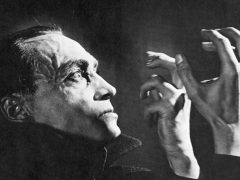
The Hands of Orlac stands out as one of the most important post-expressionist films, with a strong horror component and a character reminiscent of even the most modern international detective stories. Robert Wiene once again made history.