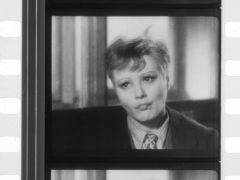
Peter is a rather innovative film for its time. And Henry Koster, for his part, wasn’t afraid to go over the top, to stage deliberately extreme situations, or to tell the audience a story that, through the genre of comedy, sought to tread uncharted territory. At the Diagonale 2026, as part of the Girls will be Boys retrospective.
The short documentary Schlösser und Burgen im Burgenland aims for the most essential staging possible, with few captions appearing on the screen each time a new castle is presented to us, without the need for any voice over.
“Bloch-Ziehen” im Burgenland is a little gem of Austrian cinema, which not only shows us a tradition unknown to most today, but is also a perfect depiction of an unusual and alienating era.
In little more than three minutes, Ein Spaziergang durch Graz – with the most essential directorial approach possible – successfully brings the history of the Styrian capital to life for us, while maintaining an almost impersonal and quite didactic character.
In Zwettl am Kamp – produced in 1934 by Österreich in Bild und Ton – is part of a long series of propaganda documentaries made in Austria mainly between the 1930s and 1940s.
Vorfrühling im Wienerwald immediately bears witness to a timeless beauty. A beauty that, in spite of the passing years, always seems to remain intact and unchanged. The rich and precious Wienerwald, which has been for centuries a source of pride for every Viennese.
The mood of Lunz und seine Seen is particularly romantic and contemplative, and unlike the directorial approach adopted in the numerous other propaganda documentaries made in those years, it aims above all to give the film its own, marked personality.
Presented in competition at the Venice Film Festival 1934, Maskerade won the Best Screenplay Award. While following the canons of the Wiener Films, with a story set in the world of the upper middle class, its splendour, sumptuous costumes and music, both Willi Forst and screenwriter Walter Reisch wanted to give the whole thing a different touch, pointing the finger at a hypocritical and decadent society reminiscent of Arthur Schnitzler’s works.
A precocious Girl, a lively musical comedy of misunderstandings made in 1934 and directed by Max Neufeld, is a breath of fresh air. Yet, if one places this feature film within the vast production of sentimental comedies made in Austria between the beginning of the 1930s and the early 1940s, it is basically similar to many other films with, in addition, several imperfections within it.