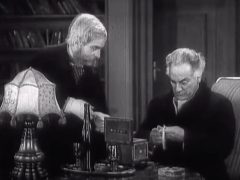
In Jewels – recently restored by Filmarchiv Austria and presented to the audience on the new channel Filmarchiv On – Hans Brückner adopted a courageous and rather innovative directorial approach, drawing heavily on what had been made in the past, but at the same time treasuring numerous influences from the rest of the world.
Kreuz und Quer durchs Burgenland immediately becomes an image of a happy era that was, unfortunately, about to come to an end, as well as a precious historical document realised between the two world wars and between two fundamental eras in film history: the silent era and the sound era.
Die Tat des Andreas Harmer is an extremely sophisticated noir, where – just as the great Fritz Lang had shown us in Metropolis in 1926 – the clear separation between good and evil is well represented on two levels by the settings, be they the basement of a building and the sewers of the city or a sunny park on a hot summer’s day.
Thinking back to Karl Köfinger’s early films, we recall how – alongside numerous static shots – he had opted mainly for totals to show the realities depicted in their entirety. Yet in Durch die Wachau, the human being himself is put in the foreground.
Sinuous bodies, together with intense close-ups, become the great protagonists of Die Warschauer Zitadelle (made in 1930 by Louise Kolm-Fleck and Jakob Fleck), which, in turn, stands out above all for its stylistic elegance, fluent camera movements and, last but not least, an excellent script that is both romantic and brutal at the same time and not at all predictable, ranking as one of the couple’s most mature films. At the Viennale 2019, within the retrospective dedicated to Louise Kolm-Fleck.