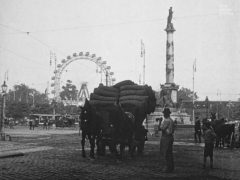
DER WIENER PRATERSTERN
A striking contrast between past and present makes the short documentary Der Wiener Praterstern even more fascinating and of great historical significance. Restored by Filmarchiv Austria and shown on the Filmarchiv On channel.


A striking contrast between past and present makes the short documentary Der Wiener Praterstern even more fascinating and of great historical significance. Restored by Filmarchiv Austria and shown on the Filmarchiv On channel.

An elementary direction that openly refers to the documentary approach of the Lumière brothers is a salient aspect within the documentary Im Auto durch die Österreichischen Alpen. And this mise-en-scène – which on this occasion also involved the camera itself being placed on the moving vehicles from time to time – deliberately avoided any particular directorial virtuosity or authorial ambitions, with the sole aim of filming reality as it was.

The railway line along which the so-called Mariazeller Bahn travelled is the oldest mountain railway line in Austria. This railway line was, around the 1910s, completely electrified, also thanks to the numerous hydroelectric power stations along its route. The documentary Eine Fahrt mit der Mariazeller Bahn gives us the opportunity to get to know this reality up close.

The documentary film Auf der Donau zwischen Wien und Budapest, produced in 1912 by Welt-Film and running just under two minutes, highlights important class differences – and lifestyle differences – especially in the countryside and small towns.

The short documentary Meran, made in 1912 and produced by the legendary Sascha-Film, is today considered one of the oldest and most precious documentaries in Austrian film history.

Branchentreffen bei der Ersten Kinoausstellung in Wien, made in 1912, stands as one of the earliest documentaries produced in Austria to show us the impact cinema immediately had on people’s lives. And the great enthusiasm documented here speaks for itself.

Das Gänsehäufel, made in 1912 and produced by the Wiener Kunstfilm is an important document of an episode in Viennese life of the past, which conveys a healthy good mood and also shows a certain essential lyrism as it becomes increasingly poetic and contemplative as we approach the finale. At the Viennale 2019, as part of the retrospective dedicated to Louise Kolm-Fleck.

While it is true that Austrian cinema was officially born in 1908 (with the film Von Stufe zu Stufe by Henz Hanus), a film like Die Zirkusgräfin – directed by writer, librettist and actor Felix Dörmann in 1912 – can be considered one of the first, worthwhile works of the aforementioned cinema.