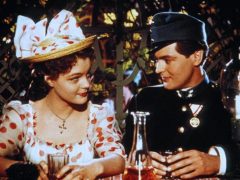
A MARCH FOR THE EMPEROR
A March for the Emperor is a milestone in Austrian nostalgic cinema, capable of transforming history into a lively and visually captivating operetta that entertains and offers a welcome break from reality at the same time.


A March for the Emperor is a milestone in Austrian nostalgic cinema, capable of transforming history into a lively and visually captivating operetta that entertains and offers a welcome break from reality at the same time.

Thanks to its foresight and the grace and care with which it was made, Waltz Melodies is now considered a true gem of early cinema. A film that makes us think, but also gives us an hour and a half of laughter and light-heartedness.

Written and realised mainly for actor Hans Moser, My Daughter lives in Vienna is a brilliant comedy of errors that takes place predominantly in one location, but at the same time features a dynamic and well-thought-out direction.

Loving Couples is a perfect example of a 1950s Austrian comedy, full of light-hearted songs and complicated situations that, in one way or another, knows how to make people smile with funny jokes, which, as we know, will never fall out of favour.

An unexpected encounter, a false identity, a series of misunderstandings that trigger the most unthinkable situations. In the case of The Congress dances, Franz Antel has attempted to tread a safe path by staging a past success, while revealing little courage in reinventing himself.

In We Invite You to a Dance, the typical Wiener Film elements are all there, and they make up an undoubtedly pleasant and well-written story, although extremely simple and with practically no subplots.

Ernst Marischka’s Two in a Car perfectly embodies the mood of the melodramatic but nonetheless entertaining post-World War II Wiener Films, also proving to be a witty portrait of the society of the time.

Willi Forst’s fictional, black-and-white version of the life of composer Franz Schubert in Lover Divine is a work that embodies the romantic Zeitgeist of the 19th century more than ever before.

Love triumphs in Court Theatre. But will it be so for everyone? And, above all, is love or career more important? How much can people’s opinions influence a person’s life? Willi Forst has staged it all with a strong lyricism, but also with the right cynicism, especially when it comes to dealing with certain dynamics within the show business and the upper middle class.

There are approximately one hundred and forty films in which Hans Moser took part during his career. And the characters that most succeeded in touching audiences were those of tender father figures, sometimes clumsy and awkward, who often went through important changes or, in any case, served to introduce small comic elements into often dramatic feature films. And so, his unmistakable mumbling voice, his reassuring appearance, as well as his innate comic verve soon became symbols of the glorious Wiener Films.