If we consider that Vienna, City of my Dreams was made in the late 1950s, at a time when national cinema had long been seeking to move in new directions, we realise how it can be regarded as a “nostalgic” film. Willi Forst sought to create a heartfelt tribute to his city, but also to an essential era in Austrian film history. Restored by Filmarchiv Austria and presented on the Filmarchiv On channel.
Karl Hartl has paid a wonderful tribute to Wolfgang Amadeus Mozart. His Whom the Gods Love – recently restored by Filmarchiv Austria and presented to the audience on the Filmarchiv On channel – still has the remarkable ability to captivate us today, many years after its release, with all its visual and communicative power.
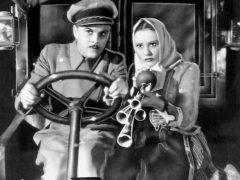
Catherine the Last – recently restored by Filmarchiv Austria and re-released to the audience on the new channel Filmarchiv On – is a feature film that is quite unique in the history of Austrian cinema. A modern fairy tale, an unusual version of Cinderella, which differed considerably from what was being produced in Austria at the time.
With Lumpaci the Vagabond, Géza von Bolváry has successfully captured the essence of a timeless story. A story that is still as relevant today as ever and that, between one gag and another, also knows how to move us.
The last great exponent of a glorious generation of actors who have entertained audiences of all ages since the 1930s, Hans Holt is a legendary figure in Austrian film history.
In We Invite You to a Dance, the typical Wiener Film elements are all there, and they make up an undoubtedly pleasant and well-written story, although extremely simple and with practically no subplots.
The Emperor Waltz, made in 1953, is a brilliant comedy of errors with a strong musical character, which is fully in line with the canons of the Wiener Film and is still overall enjoyable today.
Die kluge Marianne is an elegant and funny comedy of errors, a story that might seem anachronistic today, but, at the same time, a true declaration of love to women. A film that, even many years after it was made, is perfectly capable of filling viewers’ hearts with joy and optimism.
Compared to The Trapp Family, one almost gets the impression that The Trapp Family in America works almost on autopilot. What was successful in the first film is almost faithfully re-presented here. The music moves, but not as much as it should, and similarly, the numerous flashbacks that refer back to the 1956 feature film come across as excessively contrived.
The Trapp Family, while suffering from an overly famous, spectacular and almost ‘cumbersome’ remake, undoubtedly has a well-defined personality. And despite having – obviously – many similarities with The Sound of Music (especially with regard to some of the dialogue), it turns out to be a little gem to be discovered.