

This post is also available in:
 Italiano (Italian)
 Deutsch (German)
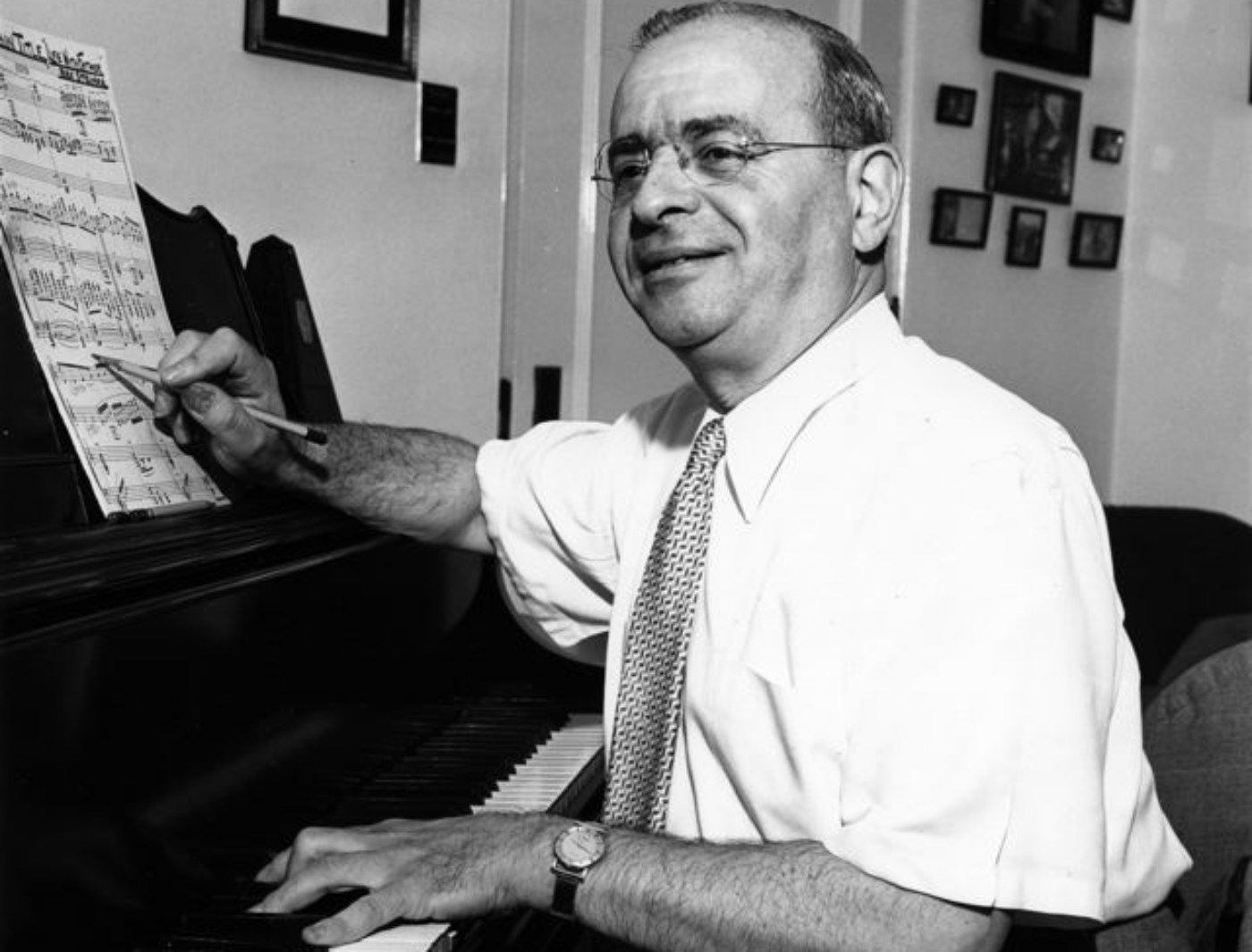
Author of over three hundred film scores and having radically changed the way films are scored, Max Steiner received, over the course of his career, no fewer than twenty-six Oscar nominations, winning three.
Telling stories through music
We are all familiar with the legendary soundtracks of feature films such as Gone with the Wind (Victor Fleming, 1939), Casablanca (Michael Curtiz, 1942), The Searchers (John Ford, 1956) and A Summer Place (Delmer Daves, 1959). Well, all these soundtracks were composed by a man who has rightfully earned his place in film history, helping to make numerous films truly memorable. We are talking about Max Steiner, widely regarded as ‘the father of film music’, who composed more than three hundred soundtracks during his career.
Indeed, even from a first, brief reading of Max Steiner’s biography, we realise that the author could not have done anything other than devote his entire life to music, thereby achieving fame and success. Born on May 10, 1888, in Vienna, Maximilian Raoul Walter Steiner was the grandson of Maximilian Steiner (1839–1880), manager of the Theater an der Wien, whilst his godfather was actually Richard Strauss. From childhood, therefore, young Max showed a keen interest in music, as well as, of course, extraordinary talent; he began studying piano with Johannes Brahms and enrolled at the Imperial Academy of Music and Performing Arts in Vienna, where he was taught by Gustav Mahler and completed his four-year course of study in just one year.
Desiring to expand his experiences, Max Steiner moved to London at the beginning of World War I, before setting off shortly afterwards for the United States, arriving in New York that same year with just thirty-two dollars in his pocket. Here, however, his success was some time in coming, and it was not until 1929 – after fifteen years spent working as an arranger and conductor on Broadway – that he decided to move to Hollywood.
It was here, finally, that Max Steiner had the opportunity to show his talent. Indeed, after composing his first soundtrack for the feature film The Case of Sergeant Grischa (Herbert Brenon, 1930), he began to receive an increasing number of offers, culminating in 1933 with the composition of the score for the cult classic King Kong, directed by Merian C. Cooper and Ernest B. Schoedsack. By that point, Steiner had become a highly regarded figure in the film industry. But before we look back at some of the major films for which he composed music, we need to consider how, in fact, he came to understand film scores themselves.
When cinema made the transition from silent to sound films, as we all know, the technical difficulties involved in ensuring that sound could be synchronised with the images in an effective and convincing manner were considerable. Among the various challenges, for example, was the need to avoid confusing the audience by inserting extradiegetic music during certain scenes (a technique to which audiences were not yet accustomed). In this regard, Max Steiner began to find the first solutions to the problem, initially introducing music into silent scenes (such as love scenes, for example) and then gradually ‘acclimatising’ the audience by also incorporating short musical passages as a background to the dialogue.
As a true lover of classical music, Max Steiner also drew inspiration directly from Richard Wagner (who, in his view, might have been the greatest film composer of all time had he been born in the modern era). Indeed, he drew inspiration from Wagner to turn his soundtracks into true leitmotifs for the stories he was bringing to the screen, and he made the whole thing even more personal by assigning a specific motif to each individual character, thereby enriching their characterisation.
Max Steiner, therefore, through an extremely precise and meticulous analysis of the film, used to accompany the characters and the narrative in a way that no one else had done before. Yet, for many of the innovations he introduced to his field, he was often criticised at first (although certain approaches have since become almost standard practice in film music). Many people initially disapproved, for example, that Steiner frequently used the technique known as ‘Mickey Mousing’, literally synchronising the music with the characters’ actions in order to emphasise them. Similarly, many criticised him for not choosing pieces of classical music for the films he scored (but this was a deliberate choice on Steiner’s part, so that a piece of music already widely known would not distract the viewer’s attention from what was happening on the movie screen). Images come first. And by emphasising them in this way, it is often the music from certain films that has ultimately been most fondly remembered.
Thanks to his talent and his desire to experiment, Max Steiner’s career was, in fact, marked by one success after another. In addition to the titles already mentioned, he composed the scores for – just to give a few examples – feature films like The Conquerors (William A. Wellmann, 1932), Little Women (George Cukor, 1933), A Star Is Born (William A. Wellmann, 1937), Arsenic and Old Lace (Frank Capra, 1944), The Big Sleep (Howard Hawks, 1946), The Treasure of the Sierra Madre (John Houston, 1948) and The Caine Mutiny (Edward Dmytryk, 1954).
As already mentioned, Max Steiner composed over three hundred film scores and was thus nominated for no fewer than twenty-six Oscars, winning three: in 1936 for The Informer (John Ford, 1935), in 1943 for Now, Voyager (Irving Rapper, 1942) and in 1945 for Since You Went Away (John Cromwell, 1944). Having passed away on December 28, 1971, in Hollywood, Steiner left behind an invaluable legacy, radically changing the way film music was approached. And his star on the Hollywood Walk of Fame (placed there in 1975, four years after his death) serves precisely to pay tribute to this great musical genius who arrived directly from Austria.